


Wagyu vs Kobe Beef: What's the Real Difference Between Them?
Schedule your Wagyu comparison. Get the real difference between Wagyu vs Kobe beef and American Wagyu. Compare origin, grading, marbling, and price.
Schedule your Wagyu comparison. Get the real difference between Wagyu vs Kobe beef and American Wagyu. Compare origin, grading, marbling, and price.

Wagyu and Kobe are not interchangeable names for expensive beef. One describes a group of Japanese cattle breeds, while the other identifies a tightly regulated product with a specific origin and bloodline. American Wagyu adds another layer, often combining Wagyu genetics with American cattle.
Shop Slickhorn Ranch's Fullblood Wagyu when you want 100% Japanese lineage raised with Northern Rockies ranch discipline.
Wagyu vs Kobe comes down to scope and certification: Wagyu is the broader category. While Kobe is a rare, regulated type of Wagyu from Tajima cattle in Japan's Hyogo Prefecture. American Wagyu is usually a crossbreed, while Fullblood Wagyu retains 100% Japanese lineage and delivers exceptional marbling.
Those distinctions affect grading, flavor, price, and how easily you can find each product in the United States. Start with what Wagyu actually means, then the differences become much easier to taste and judge.
Wagyu beef comes from four Japanese cattle breeds known for distinctive genetics and exceptional marbling: Japanese Black, Japanese Brown, Japanese Shorthorn, and Japanese Polled. Japanese Black is especially recognized for producing highly marbled beef with a rich concentration of intramuscular fat, which creates its signature tenderness and depth of flavor.
The word Wagyu simply means "Japanese cow." It describes a group of cattle breeds, not one single cut, grade, or cooking method. That distinction matters when comparing wagyu vs kobe: Kobe is a tightly defined regional brand, while Wagyu is the broader category.
Japan recognizes four Wagyu breeds: Japanese Black, Japanese Brown, Japanese Shorthorn, and Japanese Polled. Japanese Black is the breed most often associated with the intense marbling people expect from premium Wagyu. Japanese Brown, Shorthorn, and Polled cattle each have their own history and characteristics, but they share the foundation of Japanese breeding and selection.
These breeds are not interchangeable with any heavily marbled beef marketed under a similar name. Lineage, breeding records, and production standards help determine what a buyer is actually getting. For shoppers, asking whether the beef is fullblood, crossbred, or simply described as "Wagyu-style" is a practical place to start.
Japanese Black cattle are genetically predisposed to producing carcass lipids with higher concentrations of monounsaturated fatty acids than many other breeds. That genetic tendency helps explain why the fat is distributed throughout the muscle rather than appearing only as a thick exterior layer.
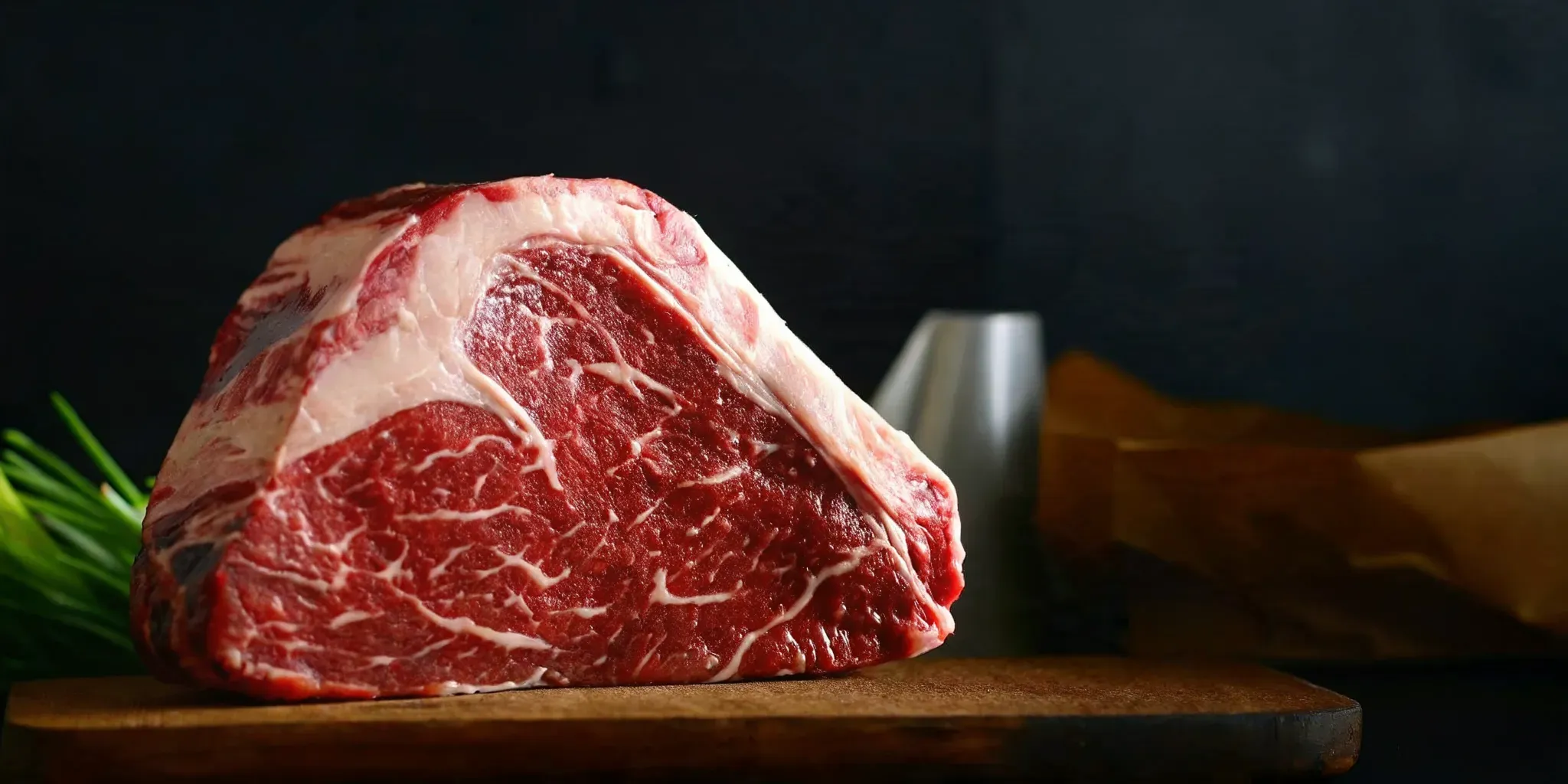
Research on Japanese Black cattle reports intramuscular fat levels exceeding 30 percent in the longissimus muscle. This is the fine, web-like marbling that softens during cooking and gives Wagyu its buttery texture. The result is not just richness for its own sake. Properly cooked Wagyu can deliver a concentrated beef flavor while remaining remarkably tender.
That same character can show up across a range of cuts, not only steaks. A cut such as richly marbled Wagyu oxtail brings the breed's richness to slow cooking, where time turns connective tissue into a deeply savory finish.
The underlying breed explains the potential, but genetics are only part of the finished product. Breeding decisions, animal care, feeding, aging, and preparation all influence what reaches the plate. That is why the label alone should not be the final word when choosing Wagyu beef.
Peer-reviewed research on Japanese Wagyu breeds and marbling provides the scientific background for these breed and intramuscular-fat distinctions.
Kobe beef is not a separate breed from Wagyu. It is a tightly regulated brand of Wagyu made from Tajima cattle raised in Hyogo Prefecture. Japan, and only beef that meets strict production and grading rules can carry the Kobe name. That narrow definition is why genuine Kobe is rare, expensive, and fundamentally different from using "Kobe" as a casual synonym for highly marbled beef.
The first line of distinction is genetics and geography. Kobe beef must come from cattle of the Tajima bloodline, one of the strains associated with Japanese Black cattle. Those cattle must be raised in Hyogo Prefecture under the standards established for certified Kobe beef. In other words, a steak can be richly marbled, exceptionally tender, and still not be Kobe if it does not meet the required origin and lineage rules.
This is the cleanest way to understand the relationship: all Kobe beef is Wagyu, but not all Wagyu is Kobe. Wagyu describes a group of Japanese cattle breeds and the beef produced from them. Kobe identifies a specific, protected product with a documented chain of eligibility. The distinction matters whenever a menu, retailer, or butcher uses the two names interchangeably.
Certification does not stop at bloodline and location. The cattle must be fed for at least 26 months and satisfy strict grading requirements. Kobe standards also include production and carcass requirements, which narrow the field further before any beef can be sold under the name. The Tajima bloodline, 26-month feeding minimum, and A4 or A5 grade requirements are summarized by The Wagyu Shop and Imperia Caviar.
Every additional checkpoint increases traceability, but it also limits supply. That is the point of certification: the name tells you more than "this beef has marbling." It signals a particular origin, bloodline, feeding period, and quality threshold.
Kobe beef commands a premium because several costs stack together. Production is limited by the eligible cattle population, the required raising period, the grading standards, and the certification process. Genuine Kobe is also extremely scarce in the United States, where it is generally found only at specific licensed, high-end restaurants rather than in ordinary retail cases.
So when comparing wagyu vs kobe, do not judge the names by marbling alone. Kobe is a rare, certified category within Wagyu. Other Wagyu, including carefully raised American options, can deliver an outstanding steak without being Kobe. The label should say exactly what it is.
Wagyu is the broader category, while Kobe is a tightly certified type of Japanese Wagyu from Tajima cattle in Hyogo Prefecture. American Wagyu and Fullblood Wagyu can deliver exceptional marbling, but they are not automatically Kobe. The meaningful differences come down to lineage, origin, grading, certification, price, and availability.
The simplest rule is worth remembering: all Kobe is Wagyu. But not all Wagyu is Kobe. "Wagyu" describes cattle genetics and the beef produced from them. "Kobe" identifies a specific. Regulated product with requirements that extend beyond marbling alone. That distinction matters when a menu or product label uses the names interchangeably.
| Type | Origin | Grading System | Marbling (BMS) | Price per lb | Availability in US |
|---|---|---|---|---|---|
| Japanese Wagyu | Japan | Japanese Meat Grading Association system | Often 8-12 | Very high; varies by cut and grade | Limited specialty importers and restaurants |
| Kobe | Tajima cattle from Hyogo Prefecture, Japan | Strict Kobe certification and Japanese grading requirements | Certified grade varies; certification is not based on marbling alone | Among the highest; varies by certified cut | Extremely limited; usually licensed high-end restaurants |
| American Wagyu | United States; commonly a Wagyu and Angus cross | Usually USDA grading, plus producer genetics and program details | Varies by genetics and management | Premium; varies by cut and producer | Available from specialty ranches, retailers, and restaurants |
| Fullblood Wagyu | United States; 100% Japanese lineage | Usually USDA grading, plus documented fullblood lineage | Can reach very high levels; USDA Prime does not capture BMS 8-12 | Premium to very high; varies by cut and producer | Rare, but available from select American ranches and retailers |
Japanese Wagyu's BMS scale helps describe marbling beyond what the USDA Prime category was designed to distinguish. Authentic Japanese Wagyu commonly reaches BMS 8-12, while USDA Prime does not account for those higher marbling levels. In practical terms, a USDA Prime label alone cannot tell you whether a steak has the lineage, marbling profile, or production history associated with Wagyu.
Fullblood Wagyu is also a different proposition from the more common American Wagyu F1 cross. F1 cattle are typically 50% Wagyu and 50% Angus, balancing rich marbling with a familiar beef-forward flavor. Fullblood cattle retain 100% Japanese lineage and represent less than 1% of U.S. cattle, which helps explain their scarcity and premium. For more detail on Wagyu beef grading, review the ranch's FAQ before comparing individual cuts.
Use the label as a starting point, not the finish line. Ask where the cattle were raised, what the lineage percentage is, how the beef was graded, and whether a claim such as Kobe is backed by certification. That is how you separate a specific, traceable product from a vague use of a premium-sounding word.
American Wagyu can mean either Fullblood cattle with 100% Japanese lineage or crossbred cattle, commonly an F1 blend of Wagyu and Angus. Slickhorn Ranch raises Fullblood Wagyu, preserving the genetics, time, and marbling that distinguish it from a typical crossbred program.
The word "American" describes where the cattle are raised, not a single genetic standard. That distinction matters when you are comparing steaks. Fullblood Wagyu has no outcross genetics and represents less than 1% of the U.S. cattle population. It is the closest American-raised expression of the original Japanese lineage, raised with the patience required to bring that potential to the plate.
Fullblood cattle take about 900 days to reach market size, compared with roughly 600 days for Angus. That additional time requires more feed, care, and capital, but it also gives the animal time to develop the rich intramuscular fat that Wagyu is known for. Fullblood is not a shortcut or a marketing label. It is a genetic distinction.
For diners who want to taste the difference, browse Slickhorn Ranch's Fullblood Wagyu beef collection.
Commercial American Wagyu is typically an F1 cross, meaning 50% Wagyu genetics crossed with 50% Angus or another American breed. The goal is a practical balance: more marbling than conventional beef with the familiar beefy flavor and production traits associated with Angus. That can be an excellent product, but it is not the same as Fullblood Wagyu.
USDA Prime is useful for evaluating conventional beef, yet the grade does not fully describe the upper marbling levels found in authentic Wagyu. BMS 8-12 marbling sits beyond what the USDA Prime scale is designed to communicate. When choosing between crossbred and Fullblood, ask about lineage, not just the word "Wagyu" on the label.
Yes, but real Kobe beef is exceptionally difficult to find in the United States. It is generally served only at a small number of licensed, high-end restaurants, while retail access remains extremely limited. For most shoppers, American-raised Fullblood Wagyu offers the more practical way to buy beef with 100% Japanese lineage.
If you are comparing wagyu vs kobe, availability is one of the clearest differences. Kobe is not simply a menu word for richly marbled beef. It is a specific, tightly controlled brand of Japanese Wagyu, tied to Tajima cattle raised in Hyogo Prefecture. That origin and certification trail matters. Beef cannot become Kobe because it has a high marbling score or because a restaurant describes it that way.
In the US, authentic Kobe is usually encountered as a special occasion restaurant item rather than something you can routinely add to an online cart. Strict production standards, limited supply, and the certification costs associated with the Kobe Beef Association all contribute to its price. Those controls protect the name, but they also make genuine Kobe rare and expensive.
For home cooks who want the genetics and eating experience behind premium Japanese Wagyu, look for clearly identified American-raised Fullblood Wagyu. Fullblood means the animal has 100% Japanese lineage with no outcross genetics. It is not Kobe, and it should not be marketed as Kobe. But it gives American customers access to authentic Japanese Wagyu genetics without relying on an exceptionally scarce imported supply.
That distinction is especially useful when shopping online. Ask whether the beef is Fullblood or crossbred, where it was raised, and how the seller documents its genetics. A Northern Rockies ranch raising Fullblood cattle offers a direct, transparent alternative: Japanese Wagyu lineage raised in the American West. With the beef shipped for your own kitchen instead of reserved for a handful of restaurant tables. Explore Fullblood Wagyu beef when you want the premium experience without confusing it with certified Kobe.
No. Kobe is a specific, highly regulated type of Japanese Wagyu from Tajima cattle raised in Hyogo Prefecture. Wagyu is the broader category, so all Kobe is Wagyu, but most Wagyu is not Kobe.
That depends on what you value. Kobe offers tightly controlled origin, production, and certification. Wagyu gives you a much wider range of choices, from American crossbred beef to Japanese and American Fullblood cuts, with meaningful differences in marbling, flavor, availability, and price.
Wagyu describes cattle descended from Japanese breeds. American Wagyu is commonly an F1 cross, meaning roughly 50% Wagyu genetics and 50% American breed genetics such as Angus. Fullblood Wagyu has 100% Japanese lineage with no outcross genetics, so the label tells you more than geography alone.
You can, but authentic Kobe beef is extremely rare in the United States and is generally served only at specific licensed, high-end restaurants. Ask where the beef came from, what certification supports the claim, and whether the seller is describing Kobe specifically or using Wagyu as a broader category.
The price reflects more than marbling. Kobe production requires strict standards, verified origin, limited supply, and certification. Those controls add time and cost throughout the process, while scarcity and demand further raise the price. Premium Wagyu can offer a more available alternative without being labeled Kobe.
If you want to put the differences into practice. Slickhorn Ranch's Fullblood Wagyu collection gives you a direct way to explore carefully raised beef with distinctive marbling and character. Shop Slickhorn Ranch Fullblood Wagyu and choose the cut that fits your next meal.
Your cart is currently empty.
Start Shopping